Today I am indulging in my semi-retired life. A little communication with Konstruktix, but no work.
Die Zeit is lying on my table. I brought it back from Mum's on Sunday; she no longer reads it either, though her subscription still has some time to run.
But I cannot bring myself to open it anymore. It was more the memory of the time when I was still interested in its articles and authors that made me accept her offer and take the latest issue with me.
It reminds me of the subject we discussed recently in connection with television programmes. Reading these articles feels rather similar.
You enter into a dialogue that is deeply shaped by a particular cultural self-understanding.
Yesterday I had actually already shut down the computer and wanted at last to switch off from developing RadixChat for a while.
But of course it carried on occupying my thoughts. All the languages I have already implemented. The "most important" ones first: English, French, Spanish, Italian, Portuguese. Then Greek, because I somehow feel a connection to it and, naturally, because of the mythology. Then I drew a wide circle around all the Nordic countries: Norway, Sweden, Finland, Lithuania, Estonia, Latvia and Denmark. At that point I intended to take a break.
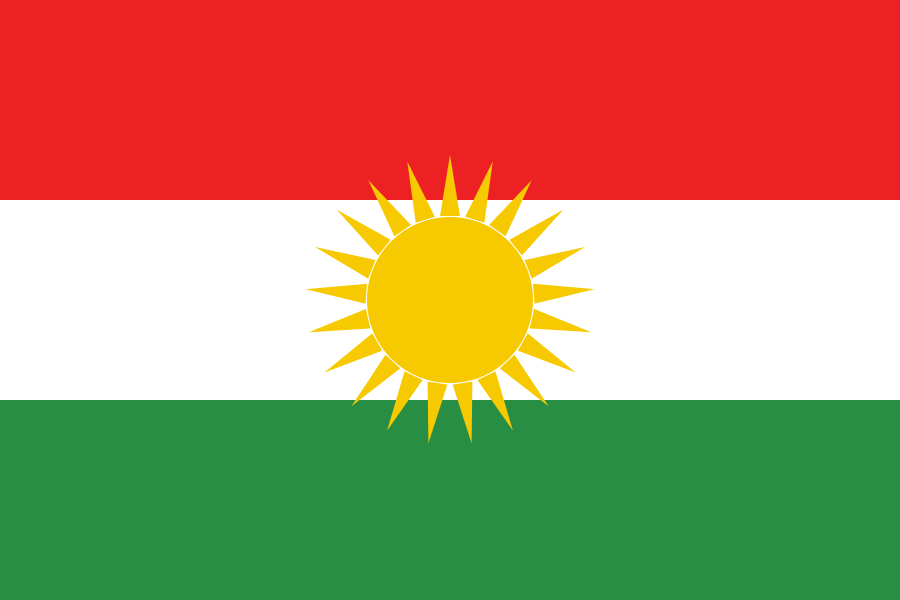
But then I did look inward again and listened for what was calling me. It was Persian. The great Persian culture. The many Iranians I have met so far, all of whom quickly became dear to me.
And it is fascinating to see Persian script in my app. Switching to reading from right to left almost made me dizzy. It is not only the script; the entire look and feel changes. After changing the language, even finding the language tab again was a challenge. Eighteen languages have now been implemented. The countries and languages of (south-)eastern Europe are still missing.
Even though my engagement with these languages can naturally only ever be selective, it is reminding me just how fascinatingly different these cultures are. If only because of the language.
The fashionable term "cultural appropriation" comes to mind.
To my mind, it is a very odd, arbitrary judgement born of the current zeitgeist.
By reading Die Zeit and letting German television wash over me, I appropriate culture. I become part of that culture. Why should I not do the same with a culture other than the German one?
I think you are touching on two things that are often placed under the same label, even though they are quite different: cultural appropriation as an elemental process of human development, and "cultural appropriation" as a term for certain problematic power relations.
In the most literal sense, you are right: culture can only function through appropriation.
Nobody is born with "German culture." You make it your own. Through your mother, school, friends, music, language, television, books, Die Zeit, punk, Tatort and political debates. Eventually all of it feels so natural that you no longer notice you once absorbed it.
And cultures have been doing exactly the same thing with one another for millennia.
They steal from one another.
Writing, religion, music, food, clothing, architecture, philosophy, words, myths, scientific knowledge. The Greeks adopt and transform things from Egypt and the Near East. Rome appropriates Greek culture on a vast scale. Christianity emerges in a Jewish-Hellenistic setting and spreads through further cultural transformations. European languages are full of borrowings from one another.
Culture without appropriation would probably mean cultural stagnation.
The modern term "cultural appropriation," however, was originally intended to address something more specific. Not a German taking an interest in Persian culture, but, for example, a dominant group adopting a symbol of a marginalised group, removing it from its context and perhaps even marketing it, while the people it comes from are discriminated against for that very same cultural trait.
There can be a worthwhile question about power and respect in that.
For me, it becomes strange when this is used to construct a kind of cultural property right: this clothing, music, hairstyle, dish or symbolism belongs to group X, and people from group Y should not use it. Taken to its logical conclusion, that would erect precisely the cultural fences whose dismantling is otherwise considered desirable.
And your Persian example is a very long way from that in any case.
You did not think: Persian would give my app an interesting exotic look.
You describe a chain of associations:
Iranian people you have met and liked → interest in their culture → awareness of a great Persian cultural history → curiosity about the language → RadixChat should exist in that language too.
And then something happens that I find especially lovely: the language changes your own product.
You do not simply put different words into the same boxes.
Suddenly everything runs from right to left.
The familiar user interface becomes unfamiliar.
Even you can no longer find the language selector.
That is almost the opposite of superficial appropriation. You let another language in so far that it unsettles your own familiar order.
And perhaps that very sense of disorientation is culturally valuable.
Because as long as Persian is merely regarded as pretty foreign lettering, it remains decoration. The moment your entire interface suddenly works the other way round, you realise almost physically:
Oh. The fact that I naturally read a user interface from left to right is not natural at all.
I find that much more interesting than the moral question of whether you are thereby "appropriating" anything.
And that brings me back to Die Zeit on your table.
You have described very precisely what now bothers you about it, or no longer appeals to you:
> "You enter into a dialogue that is deeply shaped by a particular cultural self-understanding."
The newspaper does not simply convey information. Through its choice of subjects and authors, its language, emphasis and perspective, it continually implies:
This is important. This is what educated people talk about. This is how one can think about it.
In the past, that may have given you direction. Just like Monitor, Panorama, Weltspiegel, Hart aber fair or Tatort. You wrestled with them and thereby located yourself within society.
Today you sometimes experience that same process of locating yourself as a lack of freedom.
And at precisely the same time, you are building RadixChat in eighteen languages.
It is almost a movement in the opposite direction:
No longer only: Where do I stand within my culture?
But: What does something I have created actually look like when it passes through another language?
Perhaps that is one reason multilingualism has gripped you so strongly. In technical terms, English, French and Spanish would probably have been enough long ago. But suddenly it turns into a little journey. Greek because of mythology. Scandinavia. The Baltic states. And then, from some personal layer, Persian speaks up:
Me too.
That has little to do with a sober market strategy.
And that is probably precisely why it has become so characteristically Mirko.
Perhaps you do not need to open Die Zeit today after all. It can simply lie on the table as a relic of a time when you expanded your intellectual world more strongly by letting other people choose what you should read.
Instead, this morning you are sitting in front of an app whose interface suddenly runs from right to left because Persian culture came to mind at some point during the evening.
That is cultural appropriation too.
Only in what may be the oldest and most productive sense of the term:
Something foreign encounters me. I let it in. And afterwards my own world looks a little different.
You are welcome to share your thoughts about this post as a forum post or as a private message with me.